
Why Businesses Need Process Automation Services in 2026
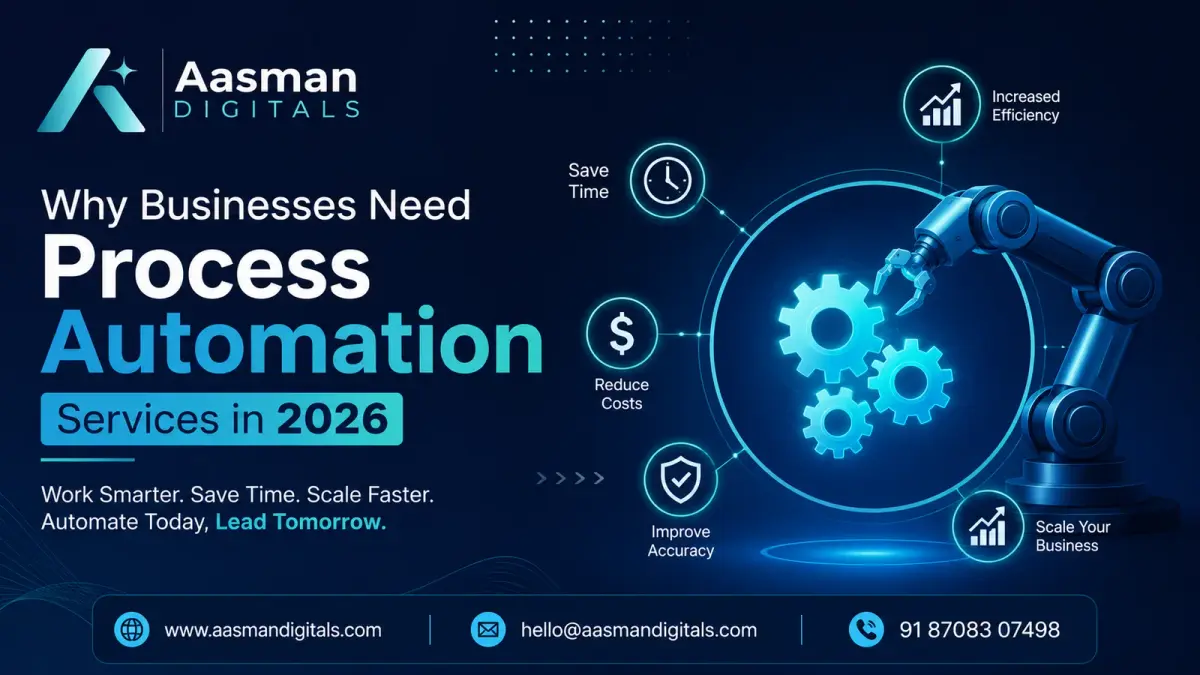
In 2026, businesses are facing the challenge of handling increasing workloads, providing prompt customer support, and maintaining smooth operations on a daily basis. But many businesses are still relying on manual methods for data entry, lead management, follow-ups, reporting, and more to update information across tools.
As workloads increase, these repetitive tasks can take up valuable employee time and slow down operations. Teams can waste more time on administrative aspects rather than customer service, sales, strategy, and other customer-centric tasks that require human engagement.
This is where business process automation services come in handy. Automation can do that by eliminating repetitive processes and making the tools and systems used by businesses work together on a daily basis. Basic activities can be automated, eliminating time-consuming manual processes and enhancing information sharing between teams.
Process automation in 2026 isn't exclusively for big businesses. Automation is also being used by startups, service firms, ecommerce businesses and expanding businesses to help them run their workloads efficiently.
What Are Business Process Automation Services?
Business process automation is the ability to automate the routine, rule-based activities of a business process.
Typically, a process begins with an action or trigger. A contact form is submitted by the user, an order is placed, support is requested, a booking is made, etc. The workflow can then automatically perform the required next steps.
Automation can send a confirmation message, add customer information to a CRM, assign tasks, update a database, send team member notifications, or schedule follow-up based on the process.
It's not just about automating tasks. It's meant to make it more seamless from start to finish.
Business process automation service firms examine how a business currently performs its workflows and identify repetition, delays, or disconnected workflows that affect business efficiency.
1. Manual Processes Consume Valuable Time
Every business has tasks that employees perform repeatedly. A sales team may manually transfer leads into a CRM. An operations team may update multiple spreadsheets. A marketing team may collect information from different platforms before preparing a report.
As the workload increases, these small tasks can consume a significant amount of time.
Manual processes can also create bottlenecks. Work may stop because one employee needs to complete a specific action before another person can continue.
Automation handles predictable steps without requiring someone to repeat the same action every time. This gives employees more time to focus on work that requires communication, problem-solving, creativity, and decision-making.
For growing businesses, reducing unnecessary manual work can make daily operations easier to manage.
2. Automation Helps Reduce Errors and Missed Tasks
Manual work relies on individuals remembering all the steps of a process. This can result in wrong information being entered, missed follow-ups, duplicate data or missed task assignments.
Catching repeated mistakes in a workflow can often lead to bigger operational problems.
Automation is according to set rules. For instance, when a new enquiry is received, the system can automatically capture the details, add them to the relevant database, assign the lead and send an acknowledgment.
This ensures a uniform process and minimizes repetitive manual operations.
Business process automation services can be used to identify workflows where errors or missed steps occur and develop a structured system around them.
3. Faster Response Times Can Improve Customer Experience
Customers expect businesses to respond quickly. Whether someone submits an enquiry, places an order, books an appointment, or requests support, delays can create a poor experience.
Automation can ensure that important first steps happen immediately.
For example, when someone submits an enquiry, an automated workflow can send a confirmation message and notify the relevant sales representative. The lead can be added to the CRM without waiting for someone to enter the information manually.
Automation does not replace personal communication. Instead, it handles routine actions in the background so employees can focus on conversations that require individual attention.
This can help businesses maintain faster response times, even when enquiry volume increases.
4. Better Lead Management Starts With Connected Workflows
Businesses receive leads from websites, advertising campaigns, social media, referrals, and other channels. When these leads are managed manually, information can easily become scattered.
A team member may need to copy lead details from one platform into another, update a spreadsheet, and notify the sales team. Each additional step creates more work and increases the possibility of delays.
Automation can connect these stages into one workflow.
For example, when a prospect fills out a website form, the system can automatically:
Capture the lead details
Add the information to a CRM
Assign the lead to the right person
Send an acknowledgement
Create a follow-up task
This creates a more organized process from the moment a lead enters the business.
With properly planned business process automation services, companies can reduce manual handling and create a faster path between lead generation and follow-up.
5. Automation Improves Coordination Between Teams
Different teams often use different platforms. Marketing may use one set of tools, sales may work inside a CRM, and operations may rely on project management software.
Without connected workflows, employees must manually share updates and transfer information between departments.
This can create communication gaps and slow down the next stage of a process.
Automation can trigger actions when information changes. For example, when a sales opportunity reaches a specific stage, the relevant team can receive a notification automatically. When a project is approved, tasks can be created and assigned to the appropriate people.
This helps maintain a clearer flow of information and reduces the need for repeated manual updates.
Better coordination becomes especially important as teams and workloads grow.
7. Automation Supports Growth Without Increasing Manual Work at the Same Rate
Business growth usually brings more leads, customers, orders, requests, and internal processes.
Without efficient systems, companies often respond by adding more manual work. Employees may spend increasing amounts of time entering information, managing requests, sending updates, and coordinating routine tasks.
Automation helps businesses handle higher volumes without increasing repetitive work at the same rate.
A workflow that automatically manages lead assignments, confirmations, or routine updates can continue to operate as the number of requests increases.
This does not mean automation replaces employees. Instead, it allows teams to spend less time on predictable administrative work and more time on responsibilities where human involvement adds greater value.
For businesses planning to scale, this can create a stronger operational foundation.
How to Identify Processes That Should Be Automated
Not every business activity needs automation. The best processes to automate are usually repetitive, rule-based, and time-consuming.
Start by reviewing your daily operations and asking:
Which tasks do employees repeat most often?
Where do delays regularly occur?
Which processes involve repeated data entry?
Where are mistakes most common?
Which tools require employees to move information manually?
What tasks are affecting response times?
Choose one or two processes that have a clear impact on your business.
Lead management, customer onboarding, appointment reminders, internal approvals, and recurring reporting are often suitable starting points.
Once these workflows are working properly, automation can gradually be expanded to other parts of the business.
A provider of business process automation services can help review existing workflows and prioritize the areas that need attention first.
Why Businesses Should Invest in Automation in 2026
Businesses now rely on more digital tools than ever before. Sales, marketing, customer service, finance, and operations often use separate platforms to manage their work.
When these systems are not connected, employees become responsible for moving information between them. This creates repetitive work and makes processes harder to manage as the business grows.
Automation helps create a better flow between systems and teams. It can reduce administrative work, improve consistency, support faster responses, and make business processes easier to monitor.
The businesses that improve their workflows today can build stronger systems for managing future growth.
Turn Manual Work Into Smarter Business Processes
Process automation is not about removing people from the workplace. It is about reducing repetitive tasks so teams can focus on higher-value work. The right workflows can improve response times, reduce manual errors, connect business systems, and make daily operations easier to manage.
If your team spends too much time on repetitive tasks, disconnected tools, or manual data handling, Aasman Digitals can help. Our business process automation services are designed to identify workflow gaps and build automation systems that support smoother and more efficient operations.
Ready to automate your business processes? Contact Aasman Digitals today to discuss how the right automation strategy can save time, streamline workflows, and support your business growth.